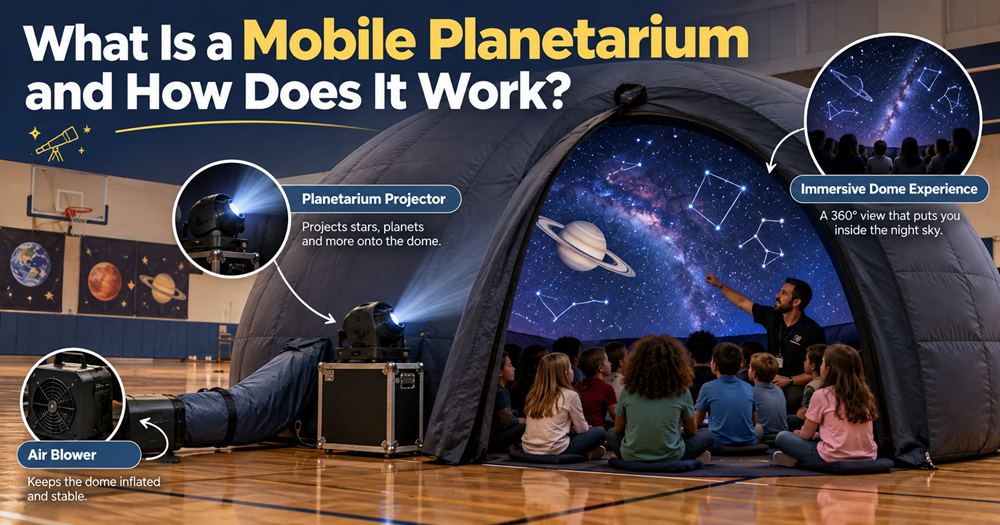
Picture the whole night sky inside your school gym. That is what a mobile planetarium does. It is a big dome that you can pack up and take almost anywhere, and inside it, a projector fills the ceiling with stars, planets, and galaxies.
In this guide, you will learn what a mobile planetarium is and how it works, step by step. We’ll cover the dome, projector, software, shows, and cost so you know what to expect.
What Is a Mobile Planetarium?
A mobile planetarium is a dome theater that travels to schools, libraries, museums, and fairs. People sit inside the dome and look up at a sky full of stars.
It goes by lots of names. You may hear it called a portable planetarium, an inflatable planetarium, or a traveling planetarium. Some people call it a pop-up planetarium or blow-up planetarium, while others call it a star dome, a space dome, or a portable dome. They all mean about the same thing.
Most new systems are digital planetariums, meaning a computer and a video projector create the sky. That makes a modern dome a mobile fulldome theater. A fulldome system shows pictures across the whole inside of the dome. It gives you an immersive dome experience because the pictures wrap around you.
What Is Inside a Mobile Planetarium?
So, what is inside a mobile planetarium? The main parts are simple.
- An inflatable dome. This is the big round tent that you sit inside.
- A fan. It blows air into the dome all the time to hold it up.
- A projector. It sits in the middle of the floor and shines the sky onto the dome.
- A computer. It runs the star software and plays the movies.
- Speakers. They play music and the host’s voice.
One museum team in England sums it up well. A fan blows up the dome, and then a 360-degree projector shows stars and planets inside.
A Short History of the Planetarium
The First Planetarium in Germany
The story starts about 100 years ago. Oskar von Miller started the Deutsches Museum in Munich, Germany, and he wanted a machine that could show the sky indoors. He asked the company Carl Zeiss AG to build it.
A Zeiss engineer named Walther Bauersfeld found the answer when he chose to shine the stars onto a dome with light. The first show took place on October 21, 1923. The machine became known as the Zeiss Model I, and it filled the dome with thousands of stars.
This optomechanical star projector used lamps, lenses, and gears. Later models used a round ball full of lenses, which people called a starball.
The idea spread fast. In 1930, the Adler Planetarium opened in Chicago as the first planetarium in the Western Hemisphere.
Planetariums for Schools
Big planetariums cost a lot of money, and Armand Spitz wanted to change that. He made small star projectors that cost much less. His company, Spitz Inc., sold them to many schools, and its 12-sided star projector ended up in hundreds of US schools in the 1960s and 1970s.
The First Portable Planetarium
Then came the first true mobile dome. In the 1970s, Philip Sadler taught middle school in Massachusetts. He took his class to the Charles Hayden Planetarium at the Museum of Science in Boston, and the kids loved it so much that they asked for a planetarium of their own.
Sadler and his students worked on the idea for years. One day he saw a big air-filled cover over the tennis courts at MIT, and that gave him the idea for an air dome. In 1977, he made the first portable planetarium.
Sadler also made a low-cost projector that uses a projection cylinder. This is a tube with tiny holes in it and a bright bulb inside. The bulb is a point-source light, so each hole makes a sharp dot on the dome. This kind of pinhole star projector is simple and tough. Teachers can swap the cylinders to show new lessons, like star maps, the Earth, or even cells.
Philip Sadler and his wife, Jane Sadler, ran the company Learning Technologies, Inc., which grew from two people into a real factory. Sadler later taught at the Harvard-Smithsonian Center for Astrophysics. In 2014, the International Planetarium Society awarded him for his work.
The Digital Age
Computers changed everything. In 1983, Evans & Sutherland released Digistar, which used one projector with a fisheye lens to show the stars. It could even fly you through space. In 2020, Evans & Sutherland and Spitz Inc. became part of a company called Cosm.
Now most mobile domes are digital. Some big domes use a hybrid planetarium system that mixes an old-style star projector with digital video. So what’s the difference between digital and analog planetarium systems? Analog stars look very sharp, but digital systems can show almost anything, from tiny cells to giant galaxies.
How Does a Mobile Planetarium Work?
A mobile planetarium works in three main steps. First, a fan blows up the dome. Next, a projector fills the dome with light. Last, the software makes the sky and runs the show.
Step 1: The Dome Goes Up
How does an inflatable planetarium stay up? It uses air. An inflation fan, also called an electric blower, pushes air in through an air tube inflation sleeve. The air inside pushes harder than the air outside, and this positive pressure holds the dome in shape. The dome’s weight keeps it on the floor.
The fan runs the whole time, which is called constant airflow inflation. Many fans have a blower speed controller, so the host can adjust the airflow. A quiet blower is a big plus because it keeps the room calm so everyone can hear.
People go in through a zippered entrance. Some domes use an airlock tunnel or an inflatable doorway tunnel, which lets people in without letting much air out. Some domes even stay up while people walk in and out, with no poles at all.
What happens if the power goes out in an inflatable dome? The fan stops, and the dome sinks slowly instead of all at once. Some domes are built to stay up during a short power cut. Many use a floorless dome design, so people can lift the edge and get out fast.
Not every mobile dome is held up by air alone. A negative pressure planetarium dome uses an aluminum frame, so it is sturdy but still easy to move.
Step 2: The Projector Fills the Sky
How does a planetarium projector work? In a digital dome, it works much like a movie projector, but with a special lens.
How are stars projected onto a dome? The trick is a fisheye lens projector. A 180-degree fisheye lens spreads the picture over the whole half-ball of the dome, which is called hemispherical projection. This gives you full-dome projection, or 360-degree projection, all around you.
Most small domes use a single-projector dome system. It is a center-mounted projector that sits in the middle of the floor. The picture it makes is a round shape called the full-dome image circle.
Dome videos use a special frame called a Domemaster. The Domemaster format is a round picture with the sky at the top center. The computer sends this round picture to the fisheye lens, and the lens spreads it over the dome.
There is another way. Spherical mirror projection bounces light off a curved mirror to cover the dome, and it can cost less than a fisheye lens. Paul Bourke, a researcher in Australia, did key work on this idea, and a company called Ash Enterprises made an early mirror system called Warped Media. Mirror systems need image warping, which means the software bends the picture so it looks right on the curve.
All systems need dome calibration to line up the picture with the dome. Distortion correction fixes spots that look stretched or bent. Large fixed domes may use many projectors at once, and they join the images with multi-projector edge blending so you don’t see the seams.
Step 3: Software Runs the Show
The projector only shows what the computer sends, and that is where planetarium software comes in. It works as a night sky simulator. It runs a real-time astronomy simulation, so the sky moves just like the real one.
Here are some well-known programs.
- Stellarium is a free, open-source sky program.
- Nightshade is a version of Stellarium made for teachers and domes.
- Celestia is a free 3D space program that lets you fly to planets.
- OpenSpace is a space program built with help from NASA and the American Museum of Natural History.
- WorldWide Telescope is a free tool for exploring the sky.
- DigitalSky comes from a company called Sky-Skan.
- Many domes worldwide use Digistar.
The star data comes from real science. Some programs use star data from Gaia, a space mission run by ESA, and they also show famous lists like the Messier catalog.
Hosts use planetarium control software to run the show, and many systems are tablet-controlled planetariums. For example, Digistar Lite can be run from a tablet. Some hosts use a wireless gamepad controller to fly through space, just like in a video game. A small computer called a planetarium media server plays the movies, and a surround sound audio system adds music and sound.
Dome Materials and Design
A dome is more than a tent. Its shape and its cloth make a big difference in what you see.
Shape
The spring line is the dome equator height. It is how high the widest part of the dome sits above the floor. A higher spring line gives you a full-hemisphere dome and lifts the dome horizon height, so the sky looks more real. A spring line of about 1.5 meters also lets people walk in and sit on chairs.
Some domes are tipped at an angle, so the choice between a tilted dome and a horizontal dome matters. A flat, level dome is best for the night sky, while a tilted dome is better for movies.
Fabric and Light
The inside of the dome is the dome projection surface, and a matte gray projection fabric works best. Gray keeps the dark parts dark. It also reduces light crosstalk, when light bounces across the dome and washes out the picture.
Many domes use two-layer dome fabric with a black outer shell and a gray inside. Some also add a blackout dome cover to make it extra dark. All of this is light-tight fabric, so no room light leaks in.
Dome seams and wrinkles can spoil the view, so good makers work hard to hide them. Some makers use special fabrics, such as Nolux from Digitalis Education Solutions. Low-cost domes often use PVC-coated Oxford cloth. Some domes are latex-free, which is good for people with allergies.
Safety Rules
Safety comes first. A good dome uses fire-retardant dome material, which means the cloth does not catch fire easily. Makers test the cloth with rules like NFPA 701, a common flame test. Some domes meet the strict California fire rules known as Title 19.
There are also hard domes. A rigid fiberglass portable dome is strong but heavy, and companies such as MMI Corporation have made both air domes and fiberglass domes.
Projector Hardware Explained
The projector is the heart of the show. Here is what to look for when you compare them.
- Type. A DLP projector uses tiny mirrors on a Texas Instruments chip. An LCD projector uses small glass panels, and a laser phosphor projector uses a long-lasting laser light source.
- Brightness. Projector brightness (lumens) tells you how bright the picture is. Small domes do not need huge numbers.
- Contrast. The projector contrast ratio compares the brightest white to the darkest black. A good black level makes the sky look truly dark.
- Sharpness. A 4K dome resolution gives a sharp picture. What counts most is pixel density on the dome, or how many dots cover each part of the sky.
Some systems add special tools. An LED star field can add tiny points of light, and Audio Visual Imagineering made SKYLASE, a laser system for the whole dome.
Large theaters sometimes use very high-end projectors. Names you may hear include the Zeiss VELVET, the Zeiss powerdome system, and the GOTO VIRTUARIUM from GOTO INC of Japan.
How Big Is a Mobile Planetarium?
How big is a mobile planetarium? Most mobile domes have a diameter of about 4 to 10 meters, or about 13 to 33 feet wide.
How many people fit in a portable planetarium? It depends on the size. One university’s mobile dome holds about 25 to 30 students. Seating capacity goes down if some people sit in chairs.
How Much Space Do You Need for a Portable Dome?
How much space do you need for a portable dome? You need more room than the dome itself, since the fan and the door take up space too. One science center requires at least 9 by 9 meters of floor space.
Check the dome height and the ceiling clearance as well. That same center needs 4.5 meters of height, so watch out for hanging lights.
Here is a quick venue checklist of indoor venue requirements.
- A big room. A school hall or gymnasium setup works best for most visits.
- A clean, dry floor. This requirement protects the dome from dirt and water.
- A solid floor. Sprung floor vibration can shake the projector and blur the picture.
- Power. Power requirements are simple, and most domes need just one or two standard plugs.
- Quiet. Noise and light control matter because the dome does not block sound.
A marquee or tent venue can also work if it has a floor and power.
Setup, Safety, and Transport
How long does it take to set up a mobile planetarium? It often takes 10 to 30 minutes. One university team takes about 30 minutes to set up and 20 minutes to pack away, so plan for setup and teardown time.
Portable planetarium transport is easy. Most kits use a flight case for the projector and a carry bag for the dome, so everything fits in a car or van.
Teams also do a planetarium risk assessment before each visit. Many carry public liability insurance in case of accidents.
Mobile Planetariums in Schools and Communities
A Field Trip That Comes to You
For schools, a mobile dome is an in-school field trip. The class does not need a bus because the sky comes to them.
It is a great tool for STEM education and astronomy education. Students get immersive learning and feel like part of the lesson. Teachers can ask for curriculum-aligned lessons (NGSS). The NGSS are science standards used in many US states, and some teams tie each show to these standards [19]. In England, shows can match the National Curriculum and its Key Stages. Programs cover all of K-12 science, from kindergarten to high school.
Outreach for Everyone
Museums and colleges use domes for science outreach. This is part of informal science education, or learning outside the classroom. A planetarium outreach program can reach towns far from a big city, and museum outreach brings the museum to the people.
Here are a few real examples.
- The University of St Andrews in Scotland runs a mobile dome, and astronomy PhD students lead the shows.
- TELUS World of Science Edmonton in Canada offers live sky shows for schools.
- Green Bank Observatory in West Virginia runs night sky shows in a portable dome.
- WonderDome in the UK brings domes to schools and halls.
Domes are also big hits at library and community events. In the UK, libraries often host domes during British Science Week. Families also book a mobile planetarium for birthday parties.
Who Runs the Show?
A planetarium presenter runs each show. A person who works in a planetarium is called a planetarian, and many have a science background. Some teams add an Ask an Astronomer Q&A after the show.
Good hosts get operator training, so they learn to set up the dome, run the software, and keep people safe. Groups like the British Association of Planetaria and the IPS Portable Planetarium Committee share tips and guides.
Mobile Planetarium Solutions from EPI Domes
If you want a dome of your own, EPI Domes designs and builds domes, mobile planetariums, and full projection systems. It works with schools, museums, science centers, event companies, and private business owners. Its projection domes range from 3 to 25 meters wide.
Choose the dome type that fits your plans.
- Inflatable planetarium domes are light and quick to set up, which makes them great for mobile outreach.
- Negative pressure planetarium domes have an aluminum frame, so they are sturdy but still mobile.
- Steel planetarium domes are built to last for long-term use.
- Perforated planetarium domes use metal screens with tiny holes and can work as outdoor structures.
- Custom projection domes are made to fit a special space or idea.
EPI Domes also offers low-cost, portable mirror projection systems; portable, flexible fisheye projection systems; and multi-projector systems for top picture quality. The team helps with setup, calibration, and training, and it offers full-dome consultancy to help you plan your project.
Fixed vs. Mobile Planetarium
How does a mobile dome compare to a big one? Here is a simple look at fixed vs. mobile planetarium options.
| Feature | Mobile Planetarium | Permanent Planetarium Dome |
| Size | 4 to 10 meters | Often much larger |
| Seats | About 25 to 35 | Often hundreds |
| Place | Comes to you | You go to it |
| Cost to visit | Low | Higher |
| Feel | Cozy and close | Big and grand |
A permanent planetarium dome is built into a building. Famous ones include Griffith Observatory in Los Angeles and the Royal Observatory Greenwich in London. They are amazing, but not everyone can travel to them. A mobile dome brings the sky to places without their own planetarium.
The IMAX Dome (OMNIMAX) is a cousin of the planetarium. It shows giant movies on a tilted dome and is used mostly for films, not live sky tours.
Other Options
Other ways to see a pretend sky include:
- A virtual planetarium is an online show, often on a video call.
- A VR planetarium uses a headset, which is great for one person but not for a group.
- A home planetarium projector is a small star light for a bedroom.
- A planetarium app turns your phone into a sky map.
- A dome cinema or projection tent is often used for parties and events.
None of these give the same shared feeling as sitting in a real dome with other people.
Frequently Asked Questions
Is a Mobile Planetarium Safe for Kids?
Is a mobile planetarium safe for kids? Yes. Trained staff run each show, keep kids away from the projector, and help everyone in and out.
What Age Is a Mobile Planetarium Suitable For?
What age is a mobile planetarium suitable for? Almost any age. Many school programs serve kids from kindergarten through high school, and some libraries even hold adults-only shows. Early years (EYFS) astronomy sessions use simple words and bright pictures. Some shows require kids to be about 4 or older, since they must sit in the dark for a while.
Can a Mobile Planetarium Be Used Outdoors?
Can a mobile planetarium be used outdoors? Most inflatable domes are made for indoor use because wind, rain, and sunlight cause problems. For outdoor events, a sturdier structure is a better fit, such as a perforated planetarium dome built for outdoor use.