Picture a dark room shaped like half of a ball. Stars fill the sky above you, and planets drift past. That is the magic of a planetarium dome.
But not all domes are built the same way. Some are held up by air that is pushed in. Others get their shape from air that is pulled out. This guide compares negative-pressure and positive-pressure planetarium domes in plain words. You will learn how each one works and where each one shines. You will also learn how to choose a planetarium dome that fits your group.
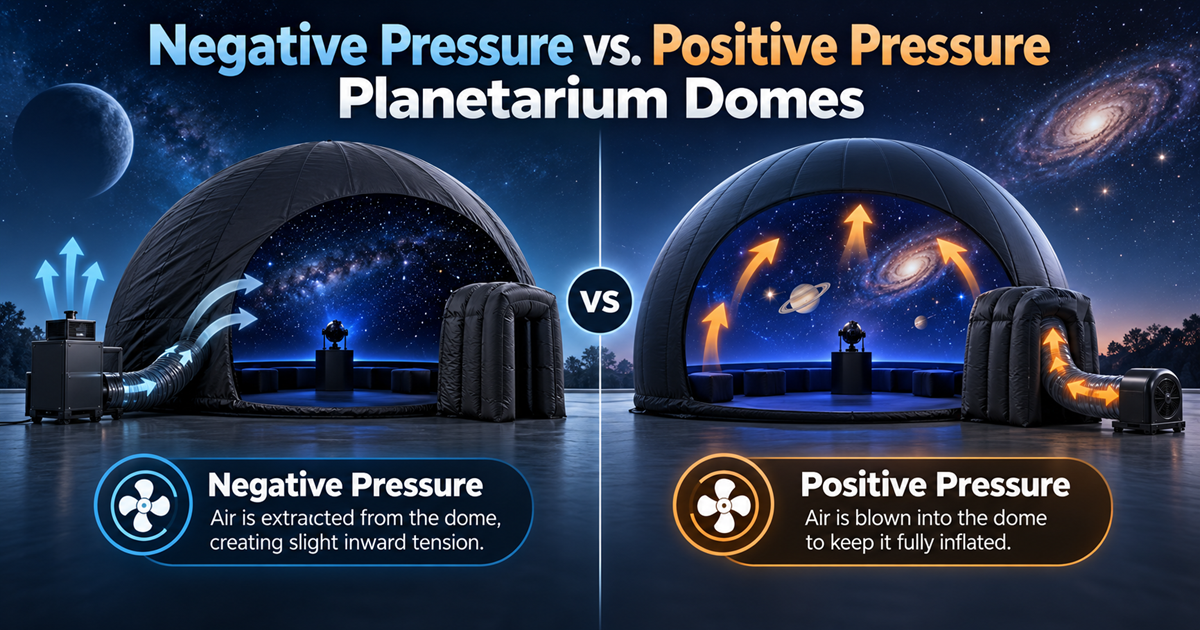
Quick Answer: A positive-pressure dome is inflatable. A fan blows air in, and that air holds the dome up. A negative-pressure dome has a stiff frame. A fan pulls air out from behind the screen, and this stretches the screen smooth. Inflatables are lighter, cheaper, and faster to set up. Negative-pressure domes provide a smoother picture and a quieter show. They also stand up better to the wind.
What Is a Positive Pressure (Inflatable) Planetarium Dome?
An inflatable planetarium dome is the most common kind of portable dome. Some people call it an air-supported projection dome. It has no frame inside, so air does all the work.
How the Continuous Inflation Blower Works
A continuous inflation blower pushes air into the dome while it is in use. This raises the air pressure inside the dome. It becomes a little higher than the atmospheric pressure outside. That small air pressure differential keeps the fabric round and tall. Experts measure this gap in small units called pascals.
Positive pressure means the air inside pushes out harder than the air outside pushes in. If there is a leak, air flows out, not in.
Some air always slips out through the seams and the door. This air leakage and pressure loss is normal. The fan just keeps up. In fact, a tiny pinhole will not bring the dome down. The blower keeps adding air faster than it leaks out.
Many inflatables use a centrifugal blower. This type of fan spins a wheel to move a lot of air.
The Main Parts of an Inflatable Dome
Most inflatable domes have these parts:
- A dark gray fabric shell that is also the screen
- A blower and a fabric tube that links it to the dome
- A way in, such as a zippered dome door or a tunnel entrance dome
- Vents that you can open or close
- Sometimes a floor mat
Where Inflatable Domes Are Used
A portable planetarium dome is great for school planetarium outreach. A teacher can roll it into a gym, plug in the fan, and start a lesson. That makes it a popular mobile dome for STEM education. It is also a smart pick for a traveling planetarium show.
Dome inflation time is short. Starlab says its dome can go up or come down in as little as 20 minutes. It comes in 5-, 6-, and 7-meter sizes. Digitalis Education Solutions says its domes take just 5 to 10 minutes to set up or take down.
Well-known mobile planetarium dome brands include Starlab by Learning Technologies, Go-Dome, and Digitalis. Space Update, Inc. sells Go-Dome systems through its ePlanetarium brand. The Digital Starlab system even uses a custom version of the Go-Dome design.
What Is a Negative Pressure Planetarium Dome?
A negative pressure planetarium dome works the other way around. Instead of pushing air in, a fan pulls air out. People in the field often call it an n-pressure projection dome.
How a Partial Vacuum Shapes the Screen
This dome has two fabric layers. One is an outer cover that wraps the frame. The other is an inner screen. Together, they make the outer cover and inner screen envelope.
An air extraction blower pulls air out of the thin gap between these two layers. This makes a partial vacuum in that gap. The screen then gets pulled into a perfect dome shape. The result is a vacuum-tensioned dome screen. You may also hear it called a partial vacuum dome screen.
Fulldome.pro explains it simply. The outer cover hugs the frame tightly. The screen stretches up and out toward the frame, but it never touches it. So the screen floats in place.
A negative pressure projection screen only needs a small fan. Skypoint Planetariums says its fan is small and quiet, much like a computer fan. It is a high-volume, low-pressure fan. That means it moves lots of air gently.
The Four Main Parts
A typical negative pressure dome has four parts:
- A stiff frame, often a geodesic frame dome
- An outer cover
- The screen
- The fan
A geodesic dome is made of many triangles. The inventor Buckminster Fuller made this shape famous. Triangles spread stress across the whole frame. So a light frame can cover a big space.
Frames come in different materials. You may see an aluminum-frame dome or a steel-frame dome. Some use a fiberglass and carbon fiber rod frame. Skypoint builds its frame from a web of these light rods. Its cover and screen use a polyamide-coated dome fabric with a flame-retardant layer.
Indoor, Hanging, Tilted, and Outdoor Types
Negative pressure domes come in many forms:
- Free-standing dome structure: The frame stands on the floor.
- Suspended dome screen: The dome hangs from the ceiling. Emerald Planetariums says its Emerald LITE domes can hang from almost any surface. They come in sizes from 3 to 12 meters. If you plan to hang a dome, first make sure your ceiling can support the weight.
- Tilted projection dome: The dome leans forward. This works well for rows of seats.
- Horizontal dome orientation: The dome sits level. This is great when people lie down or sit in a circle.
Front Pictures builds indoor and outdoor versions with level or tilted screens. Its outdoor domes use a PVC outer cover or fiberglass fabric as a weatherproof dome cover. Buyers can also add a thermal insulation layer for domes that face heat or cold.
Note: This Is Not a Hospital “Negative Pressure: You may know about negative pressure rooms in hospitals. Those rooms pull air out so germs cannot escape. A planetarium dome is different. Only the thin gap behind the screen has low pressure. The audience sits in normal air, just like in any room.
Negative Pressure vs. Inflatable Dome: Side-by-Side Comparison
Here is a quick look at negative pressure vs. inflatable dome features.
| Feature | Positive Pressure (Inflatable) | Negative Pressure |
| Air flow | Air is blown in | Air is pulled out |
| What holds the shape | Air inside the whole dome | Vacuum behind the screen |
| Frame | None | Stiff frame, often geodesic |
| Setup time | About 5 to 20 minutes | A few hours to a few days |
| Weight | Very light, fits in a bag | Heavier, ships in cases |
| Screen | May have some wrinkles | Smooth and tight |
| Way in | Airlock, tunnel, or zipper | Open doorway |
| Fan noise | Fan runs during the show | Quiet fan, can sit far away |
| Fresh air | Comes only from the blower | Room air flows in the door |
| Wind outdoors | Can move in the wind | Much steadier |
| Common sizes | About 4 to 9 meters | About 3 to 12 meters, and larger |
| Price | Lower | Higher |
| Best for | School visits and outreach | Museums, events, long runs |
Key Differences Explained
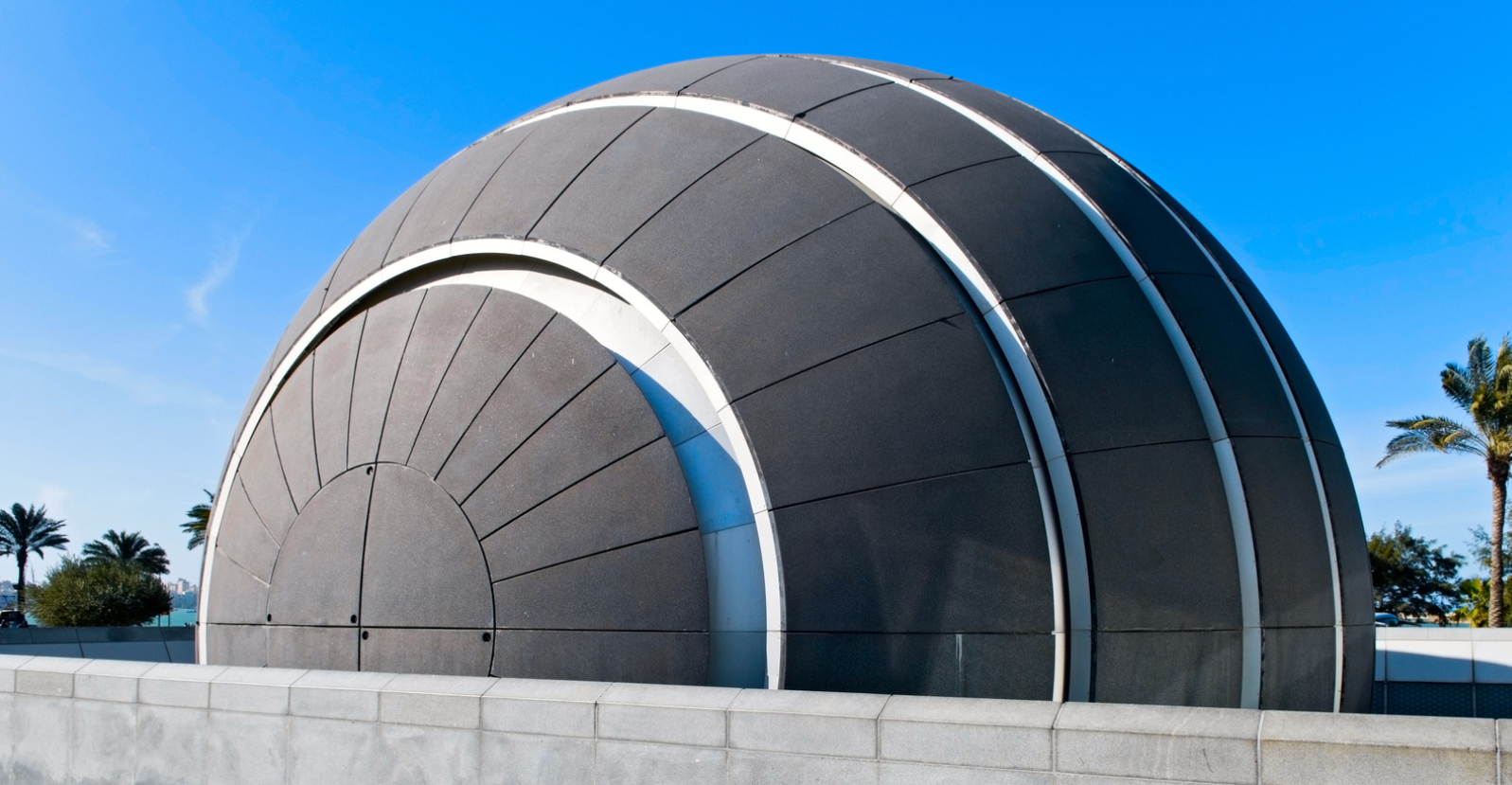
Image Quality: Wrinkles, Seams, and Screen Tension
The screen is the heart of any dome, and on an inflatable, the fabric can sag. This can distort the image on inflatable domes. Wrinkles, seams, or a slack area can bend the picture.
Good inflatable makers work hard to fix this. Digitalis uses a fabric called Nolux. It makes black areas darker and helps hide wrinkles. Go-Dome says its domes are built for digital projectors, with fewer wrinkles for movies.
A negative-pressure dome has a big advantage here. The vacuum pulls on the whole screen at once. This gives strong screen tension uniformity. It also gives good screen surface uniformity. Fulldome.pro says its method makes a wrinkle-free dome screen. This is true even on portable domes that get folded again and again.
Seams matter too. A seamless projection surface looks best. Front Pictures says its domes have imperceptible seams, which means you can barely see them. Fulldome.pro says a fabric screen often has fewer seams than a metal screen of the same size.
Color and brightness count as well:
- Dome screen gain is how much light the screen sends back. Front Pictures picks fabric with the right gain to boost contrast.
- A neutral gray projection fabric helps the image look true. Skypoint uses a neutral gray screen that blocks all outside light.
- Dome contrast and cross-reflection matter a lot. Light from one side of the dome can bounce to the other side. This washes out the picture. Special screen coatings help cut this bounce.
- A deep black level in dome projection makes stars pop. Darker fabric helps space look truly black.
Projectors and Shows Work With Both Types
Both dome types use the same kinds of projectors. So you can choose your dome and your full-dome projection system separately.
Here are the common setups:
- Fisheye lens projector: One projector with a wide, round lens sits in the middle. The Elumenati is known for this kind of system.
- Spherical mirror projection: A projector bounces its light off a curved mirror. ePlanetarium says mirror systems can give more pixels for less money.
- Single-projector full-dome setup: One projector fills the whole dome. This is common in small portable domes.
- Multi-projector edge blending: Big domes use several projectors. Software blends the edges, so you see one smooth picture.
Software does the rest. Dome warping and calibration tools bend the image to fit the curve. Most shows use the domemaster format, a round video frame made for domes. Many domes can play 360-degree full-dome content. Some can even show 3D full-dome projection.
Brightness matters as well. The right projector lumens scale with the dome size. A small, dark inflatable needs less light than a 12-meter full-dome projection dome.
Setup Time and Portability
Inflatables win on speed. Most go up in 5 to 20 minutes. They pack into a bag or case. That keeps dome transport weight and packing size small. In a 2011 list from the International Planetarium Society, a 4-meter Digitalis dome weighed about 21 kilograms, or 46 pounds.
Negative pressure domes take longer because you must build the frame first. Front Pictures says two people can set up its light indoor domes in a few hours. A 10-meter outdoor dome can take up to 5 days. That is why many people call this a semi-portable planetarium dome.
Your crew size also changes the dome setup and teardown time, and practice makes a big difference.
Do not skip dome floor preparation. Sweep the floor, look for sharp objects, and tape down all cables. This protects the fabric and prevents trips.
Entrances, Airlocks, and Audience Flow
This is one of the biggest real-world differences.
An inflatable must hold its air in. So it needs a special door. A planetarium dome airlock entrance is a short tunnel with an opening at each end. People can step in and out without letting all the air or light escape. Without it, each late guest can make the dome sag.
There are three common ways in:
- Inflatable airlock doorway: A puffed-up tunnel with two doors. Starlab uses a single upright airlock door.
- Tunnel entrance dome: A longer fabric tunnel. Classic Starlab domes used this style.
- Zippered dome door: A simple zipper opening. Digitalis uses this design.
Some users prefer zippers, and one planetarium swapped its Go-Dome for a Digitalis dome. The staff found the zipper made entry faster and easier than the airlock
ePlanetarium offers the Convertible Dome. Its doorways can be swapped to make entry easier for more people.
A negative-pressure dome doesn’t need an airlock. The audience area has normal air pressure. So you get an open doorway dome without an airlock. Guests just walk right in, which is a big plus for busy museums and events.
Noise, Air Flow, and Air Quality Inside the Dome
In an inflatable, the fan runs the whole show, so you will hear it. Digitalis offers a very quiet blower that staff can adjust from inside the dome.
Air quality matters too, because a group of 30 people in a closed dome makes a lot of heat. They also breathe out carbon dioxide, or CO2. In an inflatable, the blower also supplies fresh air. So dome ventilation and air circulation depend on that one fan. Keep shows shorter for big groups. Some inflatables also have vent holes with covers for extra air.
Negative pressure domes are quieter. Their fan moves lots of air at low pressure. Makers can add parts that muffle sound. This blower noise attenuation makes the fan even quieter. A ducted fan installation lets you place the fan far from the crowd. Since the doorway stays open, climate control inside a dome is easier. Heat or cool air from the room can flow in.
Indoor vs. Outdoor Use and Wind
The indoor vs. outdoor projection dome question is key for events.
Inflatables work best indoors, since they tend to move in the wind outside. If you must go outside, use dome anchoring with sandbags and stakes. Many inflatable kits come with sandbags, ropes, and ground stakes. Only set up outdoors if the maker says it is safe.
Negative-pressure domes have better outdoor wind resistance because their stiff frames help a lot. Go-Dome says its 6- and 8-meter Geo-Go-Domes can handle 20 mph winds and 45 mph gusts for short-term outdoor use. Front Pictures says its outdoor geodesic domes can withstand rain and wind.
Access and Emergency Safety
Everyone should be able to enjoy the show. A wheelchair-accessible portable dome needs a wide, flat way in. Some inflatable airlock doors can be made wider for wheelchairs. ePlanetarium offers doorways that a power wheelchair can roll through. Negative pressure domes with open doorways are often the easiest to enter.
Plan for a dome emergency evacuation too. Some inflatables have no floor. In an emergency, staff can flip the dome up with one pull to free everyone.
Fire safety is a must:
- Use fire-retardant projection fabric. Starlab uses a gray fabric that resists fire.
- Check for fire code compliance for portable domes. In the U.S., many fire officials look for fabric that passes the NFPA 701 test. This test includes tents and similar fabric structures.
Also think about blower failure and deflation risk. If the fan stops in an inflatable, the dome slowly sinks. The fan can be a weak spot during a busy event. Keep a spare blower close by. With a negative pressure dome, the frame still stands if the fan stops. The screen just loses some of its shape.
Durability, Cleaning, and Lifespan
Dome durability and lifespan depend on how often you move the dome. Inflatables get folded again and again. Over time, the fabric can wear out, and small holes can form. Digitalis backs its domes with a three-year limited warranty.
Negative pressure domes are often tougher. EPI Domes says they last longer while still being easy to move. Pacific Domes says framed geodesic domes are stronger and last longer than inflatables.
Fabric screens make dome screen maintenance and cleaning simple. A washable fabric dome screen can come down, be cleaned, or be swapped in a few hours. A metal screen might close a theater for days or even weeks. That makes dome screen replacement much easier with fabric.
Cost and Total Cost of Ownership
Planetarium dome cost depends on size, fabric, and extras. Here is the general picture:
- Inflatable planetarium domes are the least expensive. In a 2011 list from the International Planetarium Society, classic Starlab domes cost about $7,250 to $12,450. Go-Domes cost about $15,000 to $27,000. Prices today are likely higher.
- Negative-pressure dome prices are usually higher because of the frame. Still, it costs far less than building a permanent theater. Fulldome.pro says this kind of screen gives a dome shape at a much lower cost than old building methods.
Also count the hidden costs. Think about the projector, shipping, crew time, spare fans, and repairs. If you only need a dome now and then, consider renting a projection dome for events.
Negative Pressure Dome Pros and Cons
Here is a quick summary of negative pressure dome pros and cons, next to inflatables.
Positive Pressure (Inflatable) Dome
Pros:
- Lowest price
- Fastest setup, often under 20 minutes
- Light and easy to carry
- Great for school visits
Cons:
- Some wrinkles in the picture
- Needs an airlock or zipper door
- Fan noise during shows
- Air can get warm and stuffy
- Not great in wind
- Sinks if the blower fails
Negative Pressure Dome
Pros:
- Smooth, tight screen with a sharp picture
- Open doorway with no airlock
- Quiet fan that can sit far away
- Better in wind and outdoors
- Can hang, tilt, or stand on its own
Cons:
- Costs more
- Takes hours or days to build
- Heavier to ship
- Needs more storage space
Hybrid Designs: Domes That Use Both Pressures
Some designs mix both ideas. A U.S. patent describes a dual-pressure inflatable structure. Here is how it works:
- The walls are filled with air at positive pressure. This holds the dome up.
- The space behind the screen uses negative pressure. This pulls the screen smooth.
This makes a double-membrane dome with no stiff frame. The big win is that it needs no airlock. Guests can walk in through an open doorway.
Inflatable vs Rigid Planetarium Dome: How Both Compare to Permanent Domes
If you plan a permanent planetarium installation, you will also look at rigid domes. The inflatable vs. rigid planetarium dome choice comes down to budget and how long you plan to stay.
The first ZEISS planetarium show took place in 1923 at the Deutsches Museum in Germany. Early domes had solid plaster screens. Later, many theaters used a rigid fiberglass dome screen. But solid screens bounce sound and light. That can hurt the show.
Today, most large planetariums use a perforated aluminum dome screen. A perforated aluminum screen has thousands of tiny holes. The holes let sound pass through. This makes it an acoustically transparent dome screen. Theaters can then place speakers behind dome screen panels, so sound seems to come from the right spot. The holes also let air flow through to cool the system.
Makers of these rigid domes include Spitz, Astro-Tec Manufacturing, ZEISS, and Konica Minolta Planetarium. Spitz created NanoSeam. It calls NanoSeam the first projection dome with no folds or overlaps, so the seams are not visible. Spitz and Evans & Sutherland became part of Cosm in 2020.
Rigid domes cost a lot and also require a complex support frame. That is why many groups now choose fabric domes. Fulldome.pro says its screens can also fit inside existing domes. A dome screen retrofit can refresh an old theater for less money.
Every type still aims for the same goal: a perfect hemispherical projection screen. A hemisphere is simply half of a ball.
How to Choose a Planetarium Dome for Your Needs
Let your main goal guide you.
School and Library Outreach
Pick: Positive pressure. Inflatables are fast, lightweight, and low-cost. One person can often run the whole show. For many teachers, this is the best portable planetarium dome type for class visits.
Science Centers and Museums
Pick: Negative pressure. You get a sharper picture, an open door, and a quieter room. It works well for long exhibits.
Festivals, Events, and Outdoor Shows
Pick: Negative pressure with a clear wind rating. An immersive dome attraction must stay steady and safe outdoors. Geodesic dome makers like Zendome and Pacific Domes also build large outdoor dome structures.
Fulldome Studios and VR Rooms
Pick: A tilted or hanging negative pressure dome. Emerald Planetariums says its LITE domes suit full-dome content creation and gaming setups.
Tight Budgets
Pick: An inflatable. It gives you an immersive dome theater for the lowest price.
Size Matters
Check dome diameter and seating capacity before you buy. For example, one 16.4-foot (5-meter) inflatable holds about 25 to 30 children. Most portable planetarium domes range from 4 to 9 meters. Large fixed domes can reach 98 feet, or about 30 meters, and more.
Frequently Asked Questions
Is a negative pressure dome better than an inflatable dome?
It depends on your needs. A negative pressure dome gives a smoother picture and works better outdoors. An inflatable costs less and sets up faster. For school visits, an inflatable is often the better pick.
Do negative pressure domes need an airlock?
No. The audience sits in normal air, and only the gap behind the screen has low pressure. So people can walk in through an open door.
Can inflatable planetarium domes be used outdoors?
Sometimes, but be careful, because inflatables can move in the wind. Always anchor them well. Only go outside if the manufacturer says it is safe.
How long does it take to set up a negative pressure dome?
Small indoor models can take a few hours with two people. Large outdoor domes can take several days.
Is the air inside an inflatable dome safe for long shows?
Yes, if you plan well. The blower brings in fresh air. But big groups make heat and CO2. Keep shows short and open the vents when you can.
Which dome gives a better picture?
Negative pressure domes usually do, because the vacuum pulls the screen tight and smooth. This means fewer wrinkles and a clearer picture.
How much does a portable planetarium dome cost?
Prices change often, but inflatables are the least expensive. Negative pressure domes cost more. Permanent domes cost the most. Always ask makers for a current quote.
What size planetarium dome do I need?
Think about your group size and room height. A 5-meter dome fits about 25 to 30 children. Bigger groups need bigger domes and brighter projectors.